
Meditation and mindfulness practices disrupt irrational thoughts.
Read moreNot Sure Which Was Harder
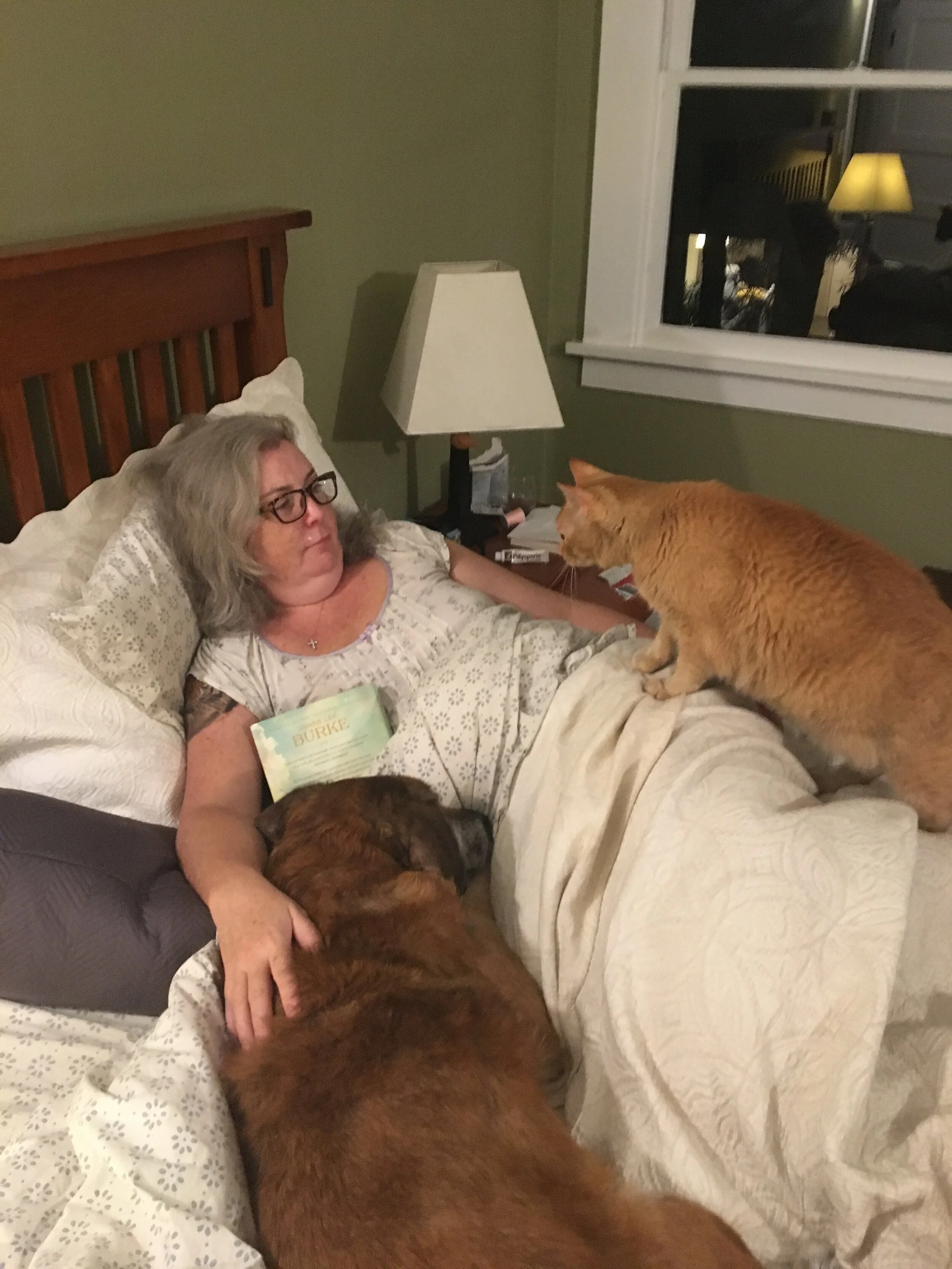
I am not sure which was harder: going to bed Tuesday night knowing it was our last night together vs. Wednesday night after you were gone. I tried not to make your last days living with me full of loud grief and gulping sobs. But as the appointment drew near, I felt more and more desperate to slow down time, turn back the clock, all the imaginary ways to keep you forever.

Joe got up early yesterday morning to sit on the porch so I wouldn’t come out to complete emptiness. Today, it is just me. If I don’t think too hard, I can imagine you are sleeping elsewhere in the house. But your essence is gone. I know/feel your presence is missing. And it hurts to know I will never again in this lifetime experience nuzzling my nose into your soft fur.

Molly – you came into my life in 2014, at a time when I was completely overloaded with un-managed stress. You saved me from going completely blind by absorbing and drawing out the negative cortisol from my body. Your goofy antics and sweet love was so cat-like and yet pure Molly Gill-esque. I have known many dogs in my life and you were unique and one-of-a-kind. With the body of a small deer!

Bonding with you was a beautiful project and as I realized your capacity for training to be my service companion, the world opened up for us. Because my disability is invisible, it took me years to confidently introduce you as a service dog. But your confidence in me was never in doubt. You went to work and served me with love, devotion, and this single-mindedness to steady me. Even with all of your own health challenges, you were patient with me feeding you meds and grooming, bathing, and bothering you with experimental lotions, wipes, sprays. All I wanted for you was to be comfortable in your own skin; your immune system eventually broke down but you never stopped being beautiful.

Last day at the beach
Did you know on Wednesday morning that going to the beach and coming home to nap WITHOUT a shower was unusual? Or did you just accept that I had forgotten to wash the sand off you? Living in the moment was your best asset. I will try to be more like you.

Big Blue Sleep Machine
Denethor – I have so much to say. And yet don’t know where to begin. Begin at the beginning and go on from there – who said that? When you showed up in the driveway on that dark Sunday night in July 2006, I could barely believe my eyes. An orange kitten? Showing up out of the blue? Just like Derek Tangye’s book! Your magic and mysticism will continue to astound me for the rest of my life.

Our first night together is burned like a movie in my memory. I remember carrying you around the block to see if anyone knew who you were or where you came from. I remember lying on the big blue sleep machine and you crawled up on my chest and buried your nose in my left shoulder/collarbone…kneading and nuzzling and purring…

Kypre and Arwen seemed to be expecting you. No one fussed. I left the back door open for days and you were always inside waiting for me when I got home. You never left.

And the way you curled up with Joe when he got home from Australia – you knew he had to be won over and you simply plonked yourself like a little spoon to his big spoon. Remember the nights you walked the edge of the hot tub while we were soaking before bed? And the night you got stuck in the tree? And the time that Arwen pounced on you from behind the garden shed because she was tired of you shadowing her? When we moved to Irvine the next year, you insisted Joe take you for a drag in the evenings. You were ‘cat-dog’ from Nickelodeon. You made us laugh. Our bed was full and after nuzzling my hair each night, you settled down on Joe’s feet.

When Arwen left in 2010, you migrated to my side of the bed. You comforted me when I was mourning her loss. You taught Shasta to sleep on the bed. You guarded us each night after I fell asleep by sitting outside on the roof. You banged your way back inside at dawn to help us start our day. You gave Richard a heart attack by enticing Shasta out on the roof one day!

You accepted the stream of visitors to our home like you were a paid Walmart greeter. I never got over your capacity to engage with people – so different from any other cat I have lived with. You loved the big parties as much as we did! And long-term live-in guests were treated to your feline affection whether they were originally cat-people or not! You made them all cat-people!

Friends
Your bond with Coco is beyond beautiful – I know you saved her many times over the years. What secrets you two share is unknown to me but I am proud that you kept her confidences and showered her with your unique brand of love. Thank you for taking care of her.
“Grief is love with no place to go” is a refrain heard during times of loss. I have so much love for both of you and am impatient for my heart to grow big enough to contain the hurt of losing you both. Grief doesn’t go away nor is it something to get over/recover from. It is an emotion that is experienced keenly and deeply when the two-way love communication becomes restricted to one-way only. When I sat with either of you, we communicated through touch and small gestures that we made up together in our love language. I told you stuff and you both listened and often replied with chirrups, meows, chuffs, sighs, etc. I loved coming home to Molly after an absence and how she would excitedly “talk” to us telling us everything that happened while we were apart! The three of us kept poor Joe awake each night with our combined snoring! I never felt alone because you two have been so integral to my day-to-day living. Thank you for giving yourselves fully to me. Thank you for your unconditional love of me. Thank you for finding me.

In five hundred twenty-five thousand six hundred minutes
How do you measure a year in a life?
How about love?
How about love?
How about love?
Measure in love...
Seasons of love...
Seasons of love...
Searching for Balance

Read moreMy approach to life coaching gives you time and space to categorize your stressors, sort through your strengths, and move forward in your life. There is nothing wrong with you.
My First "F"

I think I was in 4th grade when I received my first “F” on a school assignment. I am a curious person by nature and have always loved to learn, so school was mostly a pleasure for me and the assignments of my elementary school classes were typically interesting and usually completed on time.
Except for the spring I turned 10 years old. Near to our rural K-5 school were fields tall with spring wildflowers and fuzzy grasses. We were each asked to bring a glass jar from home and into the bottom of the jars, our teacher carefully placed cotton balls soaked in some mysterious smelling chemical. With the lids screwed back on, we set out on our nature hike from the school parking lot.
Our assignment was to collect as many butterfly samples as we could that afternoon. After they stopped moving in our jars, we were to take them out and with tiny pins mount them on a piece of styrofoam. Identifying and labeling them was the final part of our mission.
But let’s be clear – our teacher was tasking us to kidnap and kill butterflies with our home-made death traps by invading their habitat.
How could I do it? I talked to the butterflies in our family’s garden all the time. I was convinced they were special messengers from God. Butterflies have incredible superpowers; they start out as masters-of-camouflage caterpillars and metamorphose into ephemeral flashy works of art.
My jar remained empty. I distanced myself from my friends. I wouldn’t show anyone my jar on the way back to school. We were supposed to complete the pinning and labeling as homework. I never turned in a project.
When my report card came out at the end of the school year a few weeks later, I was petrified to show my parents. After dinner, I sheepishly handed over the small brown envelope and waited. Mom and Dad read it, and Dad turned to ask me what happened? Why was there an “F” in science?
Mustering my bravery, I inhaled deeply and in a big rush with heavy, hot tears streaming down my face I blurted out the details of the murderous mission with which I had been charged by my teacher. Sniffling loudly, I waited for the wrath of my parents to descend upon me.
My father simply nodded his head in agreement with me and said something about why would anyone want to hurt any of God’s creatures? Especially the pretty ones. My mother smiled and simply walked into the kitchen to get more tea.
Eventually, I would learn to draw butterflies, label their parts, distinguish different species, and come to identify with the mythology of their archetype. Most importantly, I learned that my virtues, instilled and encouraged by my parents, are a central part of my identity. In those few minutes that warm June evening, my parents recognized and honored my aptitude for appreciating beauty in the world and affirmed my strengths of bravery, honesty, love, kindness, and spirituality.
The “F” on my report card is now fondly remembered as a story about how to re-frame failure. Sure, I failed to complete a fourth-grade science project. But I also learned that my values which lead me to honor and respect the rights of all creatures do not define me as a failure. On the contrary, my very humanity is built on both loving and being loved, being aware of the feelings of other souls, and being true to myself.
#iambutterflysarah
Meditatio
In Latin, “meditatio” is a noun that translates to “contemplation.” Research has not definitely pinpointed where in the world humans first started practicing intentional meditation as part of a culture’s spiritual traditions, but we have some evidence from India and China going back thousands of years. Many religions have an introspective ritual that encourages practitioners to reflect in silence to gain perspective on challenges in life. Secular practices encourage stillness and a focus on one’s breath.
The Beatles studied transcendental meditation in the 1960s. Jon Kabat-Zinn linked meditation to mindfulness for adults starting in the 1970s. I started practicing meditation in the 1980s and became a certified meditation teacher in 2019.
In today’s world, we have a variety of meditation techniques from which to choose; science has investigated the many health benefits of meditation across a range of physical and mental conditions. I encourage you to explore what works well for you.
Cracking the Geode

Recently, a client thanked me at the end of our session for following her many threads of thought during our conversation. My training as a coach allows me to hold space for many ideas while a client explores various possibilities. She likened my coaching as walking around a very large rock. Together, we explored a metaphor of her seeing the large rock as an obstacle in her way and her search for a path over or around it; and me seeing her obstacle as a geode and finding a crack to break it open to reveal a beautiful sparkly interior.
As we concluded her session, I was flooded with a childhood memory of my grandfather’s large amethyst geode. Growing up in Ontario, Canada, I was lucky to see many amethyst geodes and other cool crystals at local fairs and artisan studios. Amethyst is the official gemstone of the province. Many cultures regard amethyst as a stone of peace and believe that wearing amethyst calms and soothes us. One of my favorite necklace charms is a simple goddess shape inset with an amethyst and was gifted to me by a friend for my college graduation.
I started my virtual coaching practice as a way to help others lean into opportunity. By actively supporting you, using applied positive psychology techniques, I help you peek inside yourself and unlock the power of your shiny potential. I don’t judge and I don’t give advice. I follow your lead and together we create a way forward for you to create the life that you want.
Where do you want to be? What’s getting in your way? How can I help you reveal your best self?
What's In Your Garden?

My father was born on a small rural farm in 1926, the eldest of eight children. In 1938, his dad died, leaving 12-year-old Murray to help his mom manage the farm and raise his younger siblings. A few years later, his mom asked if he thought they could afford to house three more children, cousins in need. He responded, “Sure - we’ll just plant a bigger garden.”
My dad grew up during the Great Depression and he was always proud that he and his family never went hungry and always had a safe place to sleep. He was an optimist with a positive attitude, trusting that he could figure out a solution to almost any problem. He did not amass any financial fortunes but his life was lived in abundant love and he treasured his big vegetable gardens.
Practicing healthy, intentional living is a lot like gardening. In the 20th century, psychiatry and psychology practitioners studied how to heal trauma and mental illness. We now know so much about weeding out that which is toxic in our lives.
But if we don’t cultivate what we actually want in our gardens, we are left with just an empty plot of dirt once the weeds are all pulled out.
What do you want to plant in your garden? Optimism? Community? Gratitude? Mindfulness? Balance? What strengths do you have that will help you grow your garden?
Finding ways to intentionally focus on what gives your life meaning and fulfillment, will help you nurture yourself and your goals in your garden. How much time are you engaging with loved ones in positive ways? How is your life’s work supporting your sense of purpose in your community? From where are you deriving pleasure and enjoyment? What does your garden look like?
Workplace Wellness Trends

Our workplaces changed during 2020. How and where and when we work has all changed. Some people are even questioning why they are working in particular industries. What do you need to achieve a sense of wellness in your job?
In 2017, “Workplace Wellness” was listed as a $48 billion industry (small orange circle in the graphic above) projected to grow to $66 billion by 2022, according to the Global Wellness Institute. Of the ten segments of the wellness industry examined, workplace wellness was last in spending. In contrast, we spent more than 22 times as much in the Personal Care, Beauty & Anti-Aging industry. Might we consider diverting some of our expenses for metallic manicures and whipped marshmallow facials towards improving our well-being at work?
GWI notes that most of the workplace wellness spending is in North America and Europe, with only one in ten workers estimated to have access to wellness programs at work. Chronic community stress, work-specific stress, work-related injuries, lingering disease, and employee disengagement contribute to economic loss over time.
“Wellness is a lifelong process.”
Researchers at Harvard University found that medical costs and absenteeism rates drop for employees engaged in workplace wellness programs. Employers who prioritize stress management, mental health, and flexible wellness options demonstrate genuine care for their employees while boosting overall productivity and health outcomes. There is no one-size-fits-all wellness program - smoking cessation classes are not needed by everyone, for example.
When we consider wellness as a spectrum, we understand that no two people are starting from the same place of wellness. My coaching, therefore, looks different for each client. What is the gap between a client’s desired career goal and their current reality? What are tangible micro-goals that move a client forward to their specific objective?
What support do you want to improve your sense of personal control in your job and increase joy in your profession?
Buddy Butler

A mentor to hundreds of people died this week. Professor Buddy Butler persuaded me in 1998 to apply to San Jose State University, so we could work together. He appointed me the Education Director of STEP (School Touring Ensemble Program) which was a multi-cultural theatre company of SJSU undergraduate students that toured K-12 schools in California performing plays with social justice messages. He cast non-traditional people in roles. He boosted everyone’s confidence. He made magic.
We met approximately one year after my divorce from my starter husband. Buddy inspired me to believe in myself and found opportunities for me to shine, as I struggled to re-build my life. The summer before graduation, he invited me to join an elite group of talented actors to research primary sources of the many paths that immigrants took to reach California in the 1800s. We learned to quilt. We visited museums and state archives. We wrote a play called California: A Common Thread.

STEP
circa 1999-2000
Buddy introduced me to his mentor, Dr. Ethel Walker, and together the two of them encouraged me to enroll in graduate school. Buddy sent me to the library to watch hours of black and white videos to help me understand the history of racism here in the U.S. As an original member of The Negro Ensemble Company (NYC) and a founding member of the Black Theatre Alliance and The Black Theatre Network, Buddy built on his family’s history of storytelling to break down barriers and find universal truths in performance.
From Buddy, I learned that it is not enough to not be a racist; he taught me to be actively anti-racist. He introduced me to the theory of anti-bias curriculum and helped me write Study Guides for student productions of shows that tackled complex issues: King, A Man and His Dream, Bang-Bang, You’re Dead, Some of My Best Friends.
In 2019, SJSU’s magazine “Washington Square” featured Buddy and included this quote:
“What is a story saying? What difference is it making? What is it revealing?” Butler asks. “I use theater as my chosen social and political platform. It’s not just entertainment. It’s cultural. It’s educational. By doing plays, I can make a difference.”
When I fell in love in 2004, Buddy immediately guessed that I had met The One. He was a keen observer and many of us who knew him have been struck by his ability to ask the right question at the right time, usually with a sly smile and a glint in his eye. He saw into our hearts and with love and attention, he directed our gaze to reflect on our own needs and desires. He helped us not just grow but to bloom and stretch towards the sun.
In the thirteen years since I moved away from San Jose, I have remained good friends with Buddy’s beloved wife, Betsy. (Buddy preferred IRL to online interactions.) I have watched their daughters grow up through online posts of the Butler family adventures. It is with tremendous sadness that I write this reflection today. Buddy loved his family.
“There are no black or white emotions. You hurt, I hurt. Pain is pain, love is love. It’s the occasion which is different, not so much the feeling. But if we break life down to the essentials, we share almost everything. The only difference is our cultural and historic context.”
-Buddy Butler
United We Fail
“You are always walking in the direction of either love or fear. Choose wisely.”
Yesterday, elected Republican officials supported an attempt to overthrow the U.S. government in favor of a man who on Saturday attempted to bully a Georgian election official to “find” more votes in a “recount.”
We just lived through an attempted coup.
I had planned to write about resilience this week. I wanted to talk about the tools and skills we can practice to positively respond to and recover from difficulties that snag and interrupt our flow. Learning how to protect ourselves from the negative effects of stress helps us handle the next crisis that crops us in our life. So, what are some of the coping mechanisms we use while glued to the news watching armed terrorists attack our federal government buildings?
For me, it is important to stay connected with my loved ones. Talking with family and friends last night helped me process my big emotions and reinforced my belief that together we can cope with national trauma. Listening to others reminds me that I am not alone in my feelings of anxiety about this crisis. My patient husband is a terrific listener and close friends are also great sources of support for me. I ask a lot of questions about what I see on the news and I try to seek multiple perspectives to limit confirmation bias.
It takes immense effort to activate positive emotions during times of trauma however this effort is necessary to break a negative thinking cycle. Our brains get addicted to the chemicals released by big emotions and we can either stay stuck in a negative feedback loop or we can consciously re-program our thoughts to focus on gratitude and love. But how to remain positive when repetitive or chronic stress has worn us down? Raise your hand if you feel like you are failing at resiliency while living through a pandemic that has also highlighted broader awareness about systemic racism, broken healthcare options, and ugly politics.
It is challenging to see opportunity in these threatening situations. High-stress chronic exposure can lead to feeling overwhelmed and fatigued. Managing our discomfort when we feel threatened means facing our fears and moving through them. Dismantling our fear may feel distressing, painful, awkward, or embarrassing. Yet when you come out on the other side, you understand better what you can control and influence. You learn that you are not helpless.
So, how can you help yourself to respond to stress with healthy behaviors? Most of us know the standard recommendations: go for a walk; drink more water; breathe mindfully; eat healthy foods, etc. Practicing resilience is possible when we build these habits of health that support our minds and bodies.
Most importantly, make time to articulate your difficult experiences and focus on what your fears during those stressful times have taught you. What have you gained since walking through an uncomfortable situation? Build confidence in your capacity to influence different outcomes for yourself. Give yourself credit for the mistakes you make, as these mistakes can be great teachers. Resilience is not about reducing or eliminating all stressful situations; resilience comes from understanding our loss and pain. We build resilience when we fail and learn from our failures.
Yesterday, this country failed. We failed. Even though the word “united” is in the name of this country, we are not very united right now. People are in pain. People are grieving. We are trying to understand how we have failed each other.
Mr. Rogers exhorted us to “look for the helpers” when watching a calamity unfold in the news. What happens when you push yourself to actually be one of the helpers? Cultivating an attitude of purpose can build resilience and help you reject feelings of helplessness. What are the ways that you can get past your fears and get involved with your neighbors, your local political leaders, your colleagues, and strengthen positive relationships in your own community? How can you help?